
Ten Pines
A short photo essay

Last week I made a trek to visit and measure ten pines on the Bald. Read on for a taste of one-man science on a former clearcut, and pop over here for backstory on the Bald.
FYI your email may clip this post in half, as I wanted to keep the photos as high-res as possible. If it cuts off, click “View entire message” to see the rest.
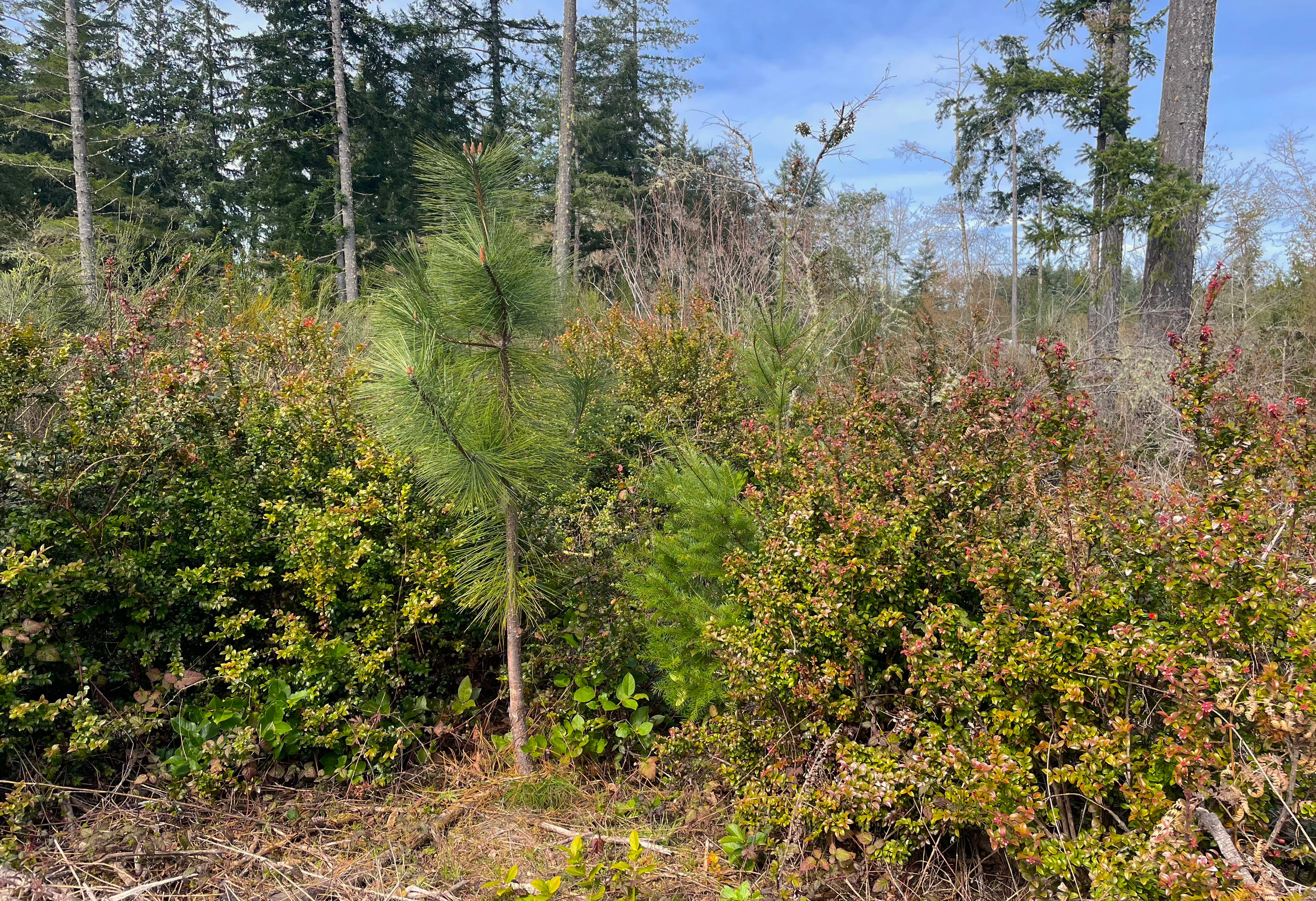
The ten pines are ponderosa pines. I planted them in April and May of 2021, just a month or two after we bought the place. A land-flipping logger clearcut the Bald in December of 2019 and replanted it, somewhat skimpily, with Douglas-fir. Our goal with the Bald is maximum biodiversity of native species, from shrubs and trees all the way up to insects to birds, so these pines are among the eclectic mix of redcedar, white pine, cascara, Pacific crabapple, serviceberry, etc., etc., we have thrown in the ground out here, alongside all the incredible native plants that have risen from the site’s long-dormant seed bank.
Every winter I return to measure the trunk thickness and height of these young trees, along with ten planted in a recently thinned neighboring forest. The tree above is R06, and this year, for the first time, it stands taller than me: 77 inches tall. Looking at my notes, it put on 18 inches last year. Nice.
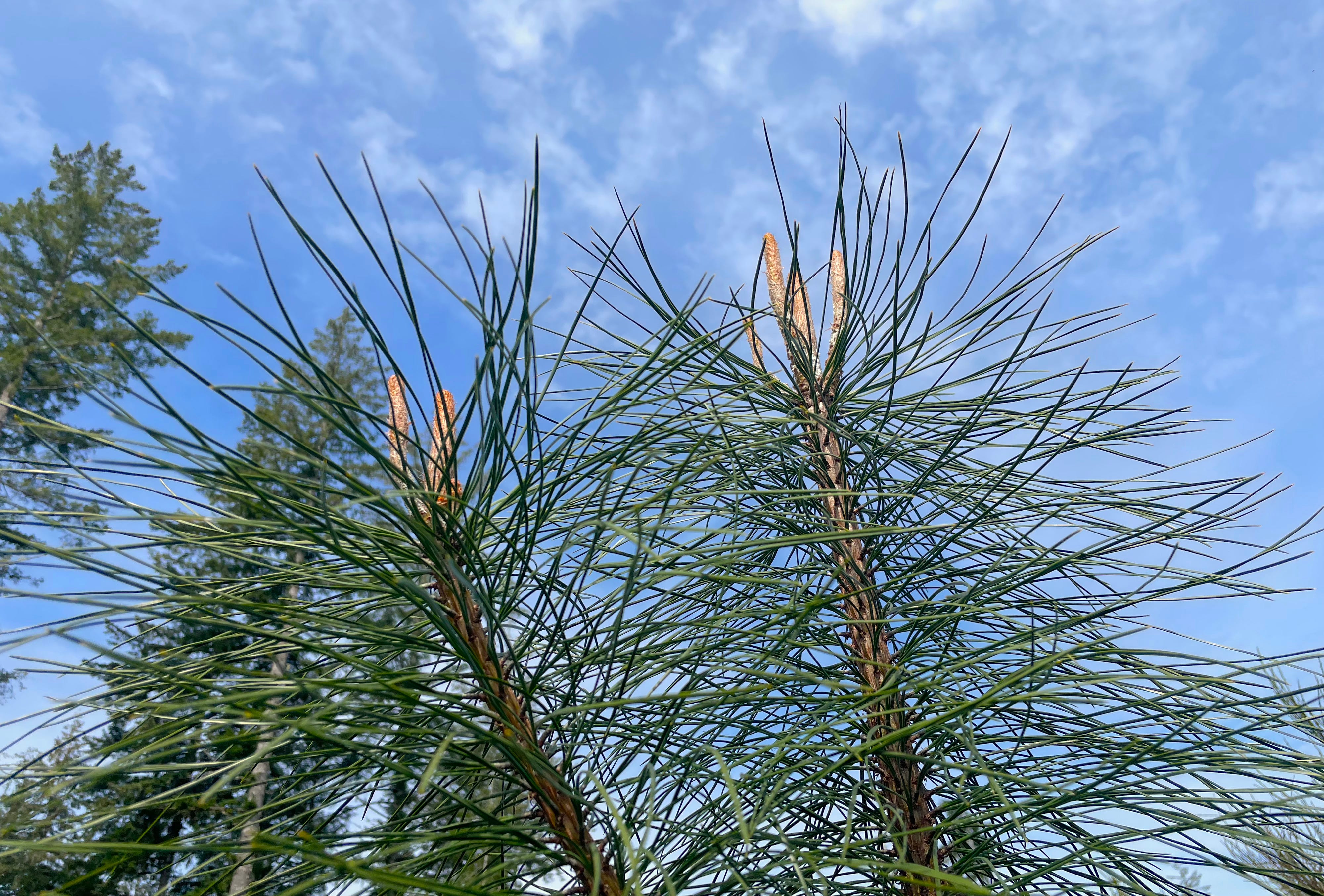
The astute among you may well be wondering why I planted ponderosa pine here on the west side of Washington—ponderosa pine, the iconic and fragrant tree of the dry interior West, the one of which Donald Culross Peattie wrote in his A Natural History of North American Trees:
Of all western Pines this one seems to the beholder most full of light. Its needles, of a rich yellow green, are burnished like metal. When the shadowless summer winds come plowing through the groves, waving the supple arms and twigs, the long slender needles stream all one way in the current, and the sunlight—astronomically clear and constant—streaks up and down the foliage as from the edge of a flashing sword. Then, when the wind is still and the trees stand motionless in the dry heat, a star of sunlight blazes fixedly in the heart of each strong terminal tuft of needles. Each tree bears a hundred such stars…
We may not have “astronomically clear and constant” sunlight around here—far from it—yet believe it or not, there is a west side ecotype of ponderosa pine that is adapted to our general dampness. It grows throughout the Willamette Valley in Oregon and has natural stands as far north as Joint Base Lewis-McChord, fifteen miles from us as the crow flies. I consider that close enough. The Willamette Valley Pine, as it is called in forestry circles, promises to handle our summers well as our summers are forced to become hotter and drier.
And R01 here is our champion so far. It was in the middle of the pack until 2023, when it shot ahead of the others. It now stands 98 inches tall, over 8 feet.
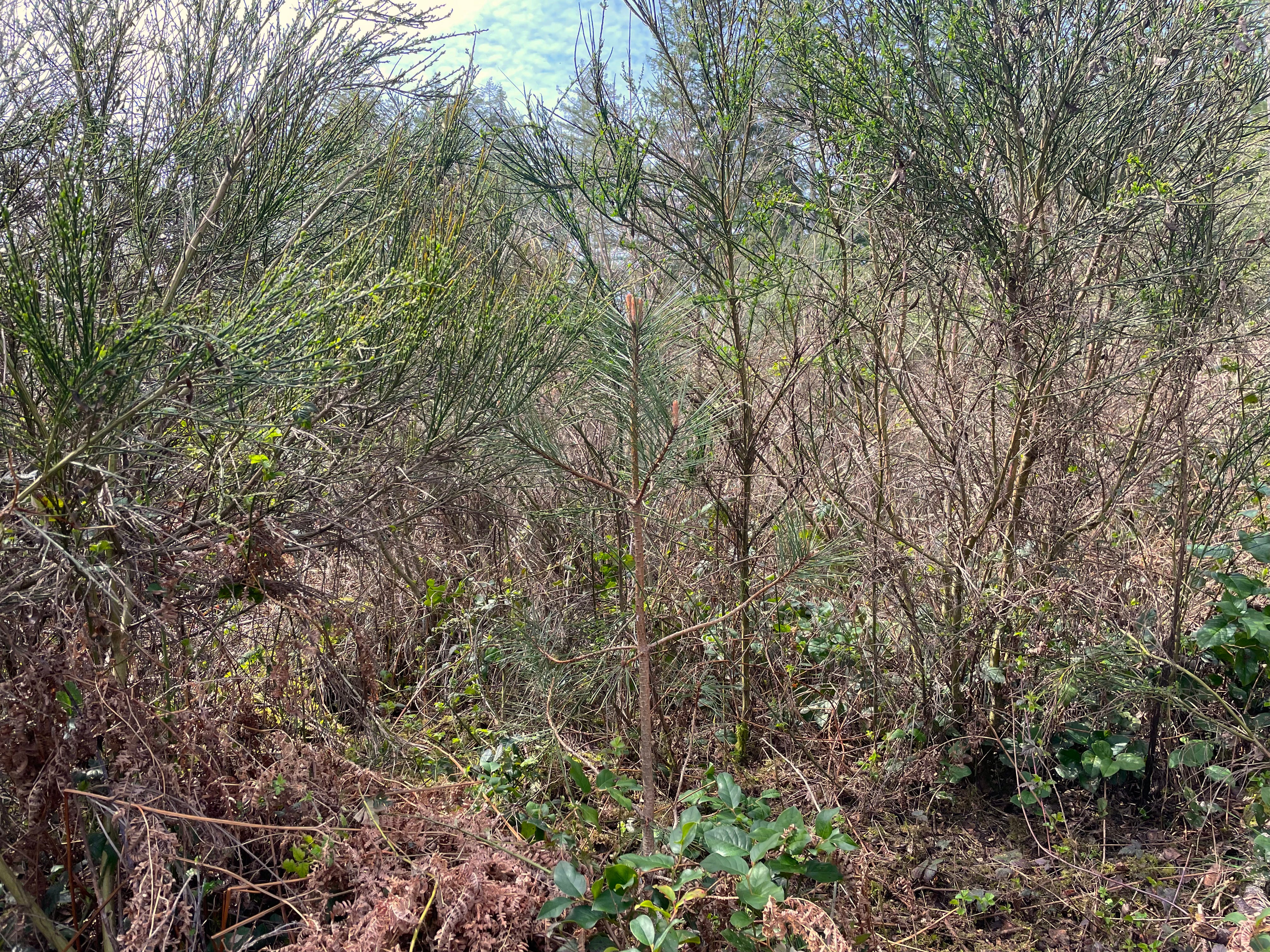
And here is the smallest. Can you see it? The going is rough in this patch. A horde of barbarians has encamped on swaths of the Bald, rough characters big and slouchy enough to swallow poor native plants whole—Scotch broom and Himalayan blackberry. My forearms collect gouges. My weaponry consists of loppers, clippers, and a folding saw. Pine R04 has been totally suppressed by Scotch broom. Its bundles of needles are thin; its trunk weak.
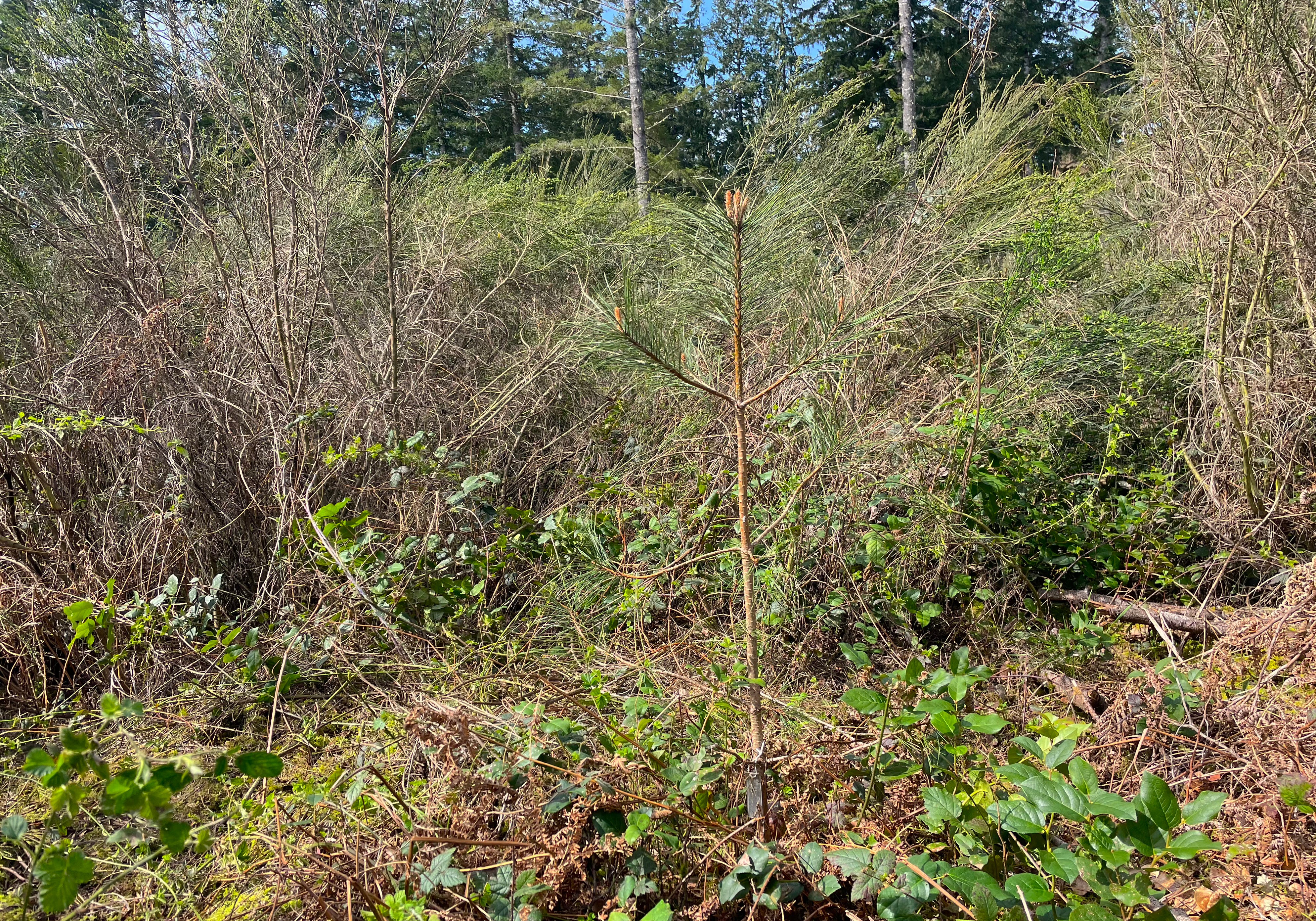
While I’m here I clear a circle around R04. “Free the Trees!” That’s the name of the game for this stage of reforestation. Unlike native shrubs, which grow apace with the trees, the barbarians grow so fast and thick they choke out the trees. In some cases they completely derail a site’s natural succession from cleared ground back to forest, resulting in what I call lost landscapes. Such places, all too common on our fragmented peninsula, are tangled, barren, flammable. No biodiversity, and no joy. And real tough to recover.
When the trees here reach 5 feet tall, they are what foresters call “free to grow”—their crowns are above the worst of the brush. Then bit by bit, over the next decade, they will shade out the broom and blackberry. Much of forestry is wonderfully slow and non-urgent, but this stage, to give the trees the nudge they need to be free and dominant, requires a whole lot of dirty work.
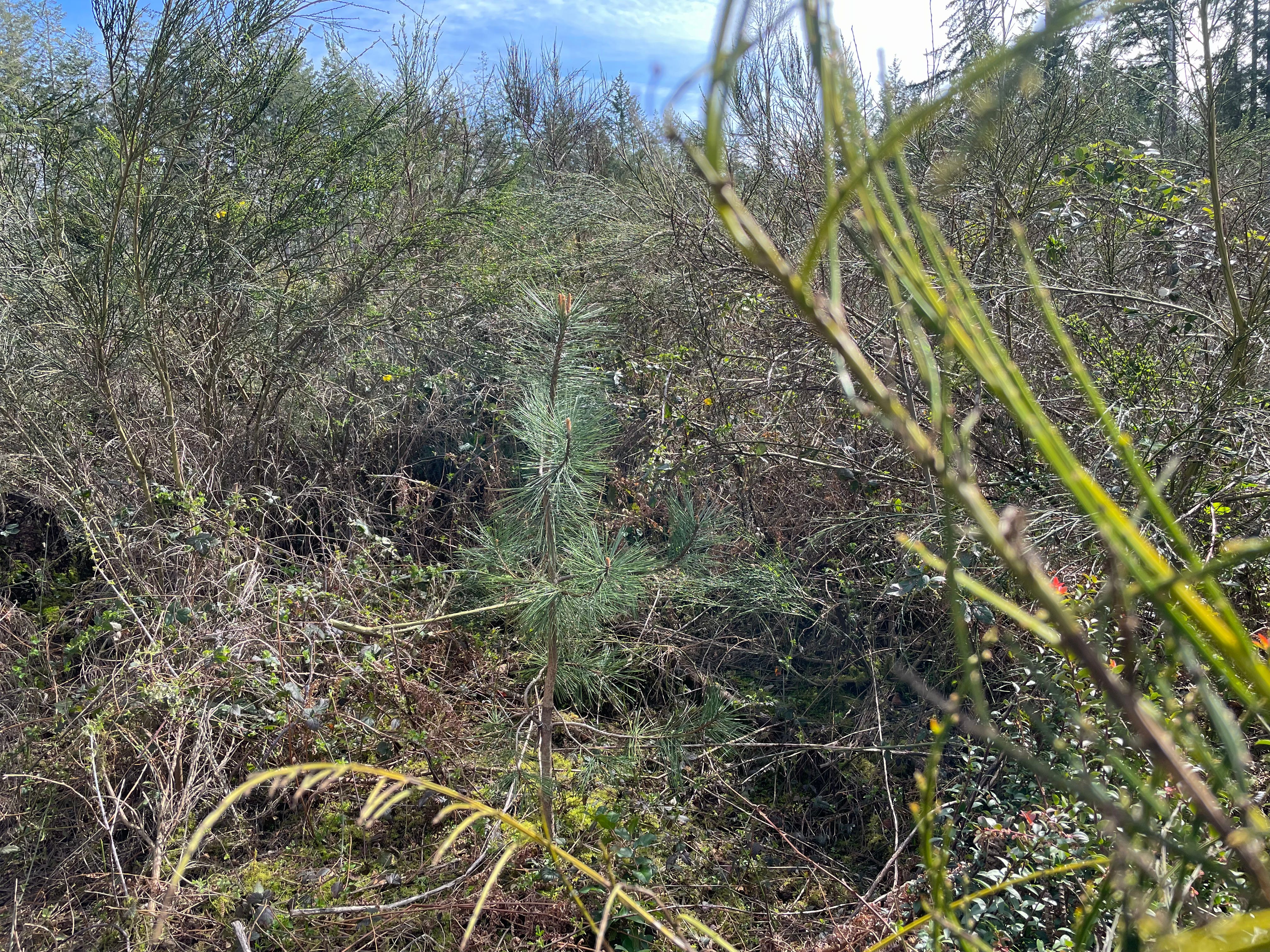
And look at that, the work pays off! R05’s pocket of space, cleared a few years ago, has stayed intact.
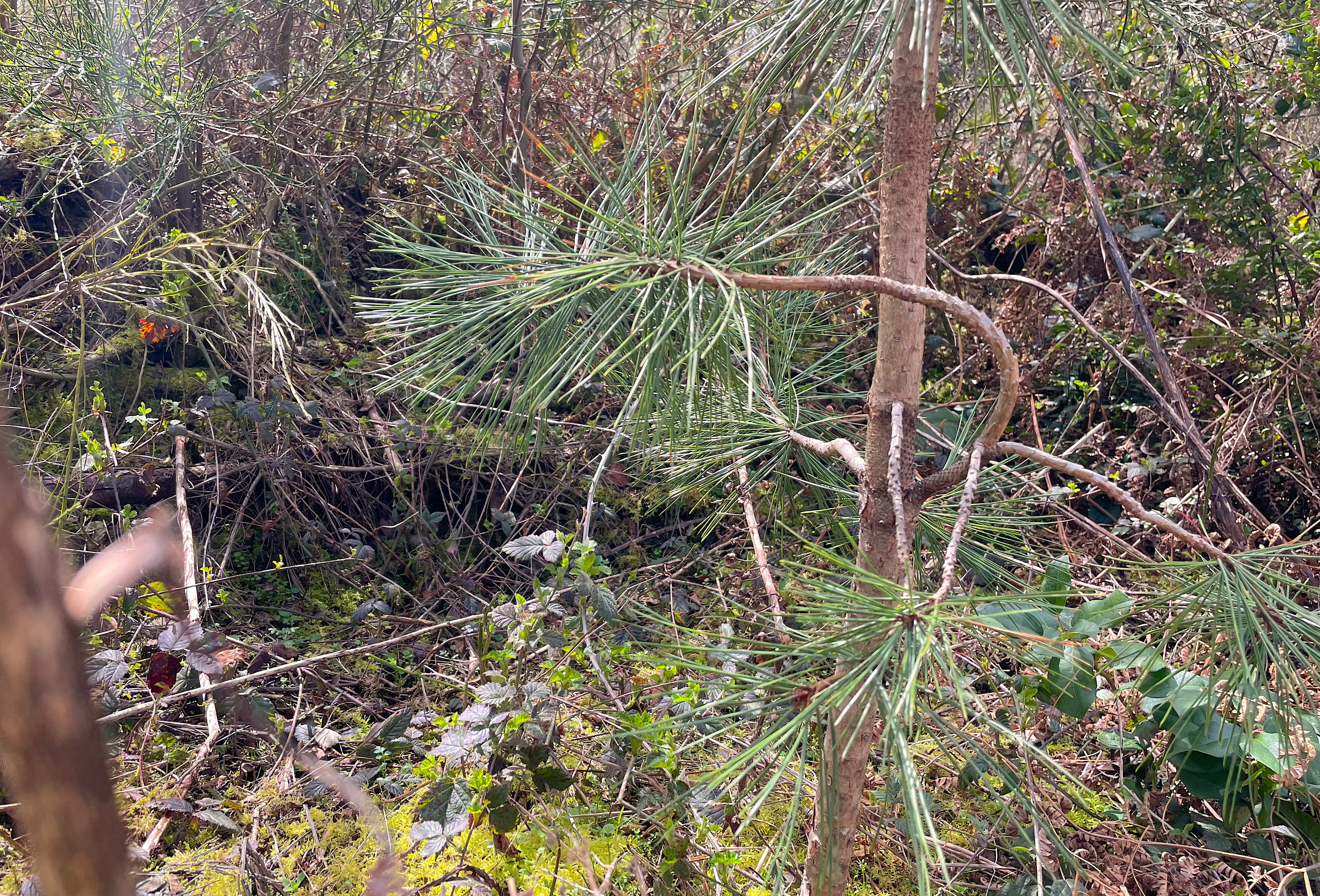
Take a closer look and you’ll see evidence that this tree was snarled, nearly swallowed. When planted, it was the second-tallest of the ten. Then in its second summer it put on only 1.2 inches of growth. I found it and freed it and this year it finally put on a solid growth spurt of 18 inches.
My own route through this space has been bent out of shape. Former paths are now walls of thorns. But I find my way, create new orders of visitation.


Within a few feet of R03 I find hairy manzanita (left, click to enlarge), a young Douglas-fir (center), several individuals of oceanspray, a willow, and a black hole of thatch ants (right). Standing well clear of the ants, I still get a few love nibbles. The Bald gardens alongside me. For the sweat I drip into the trees, it rewards me with scores of discoveries and beneficiaries, a rich native biodiversity that practically begs to burst forth.
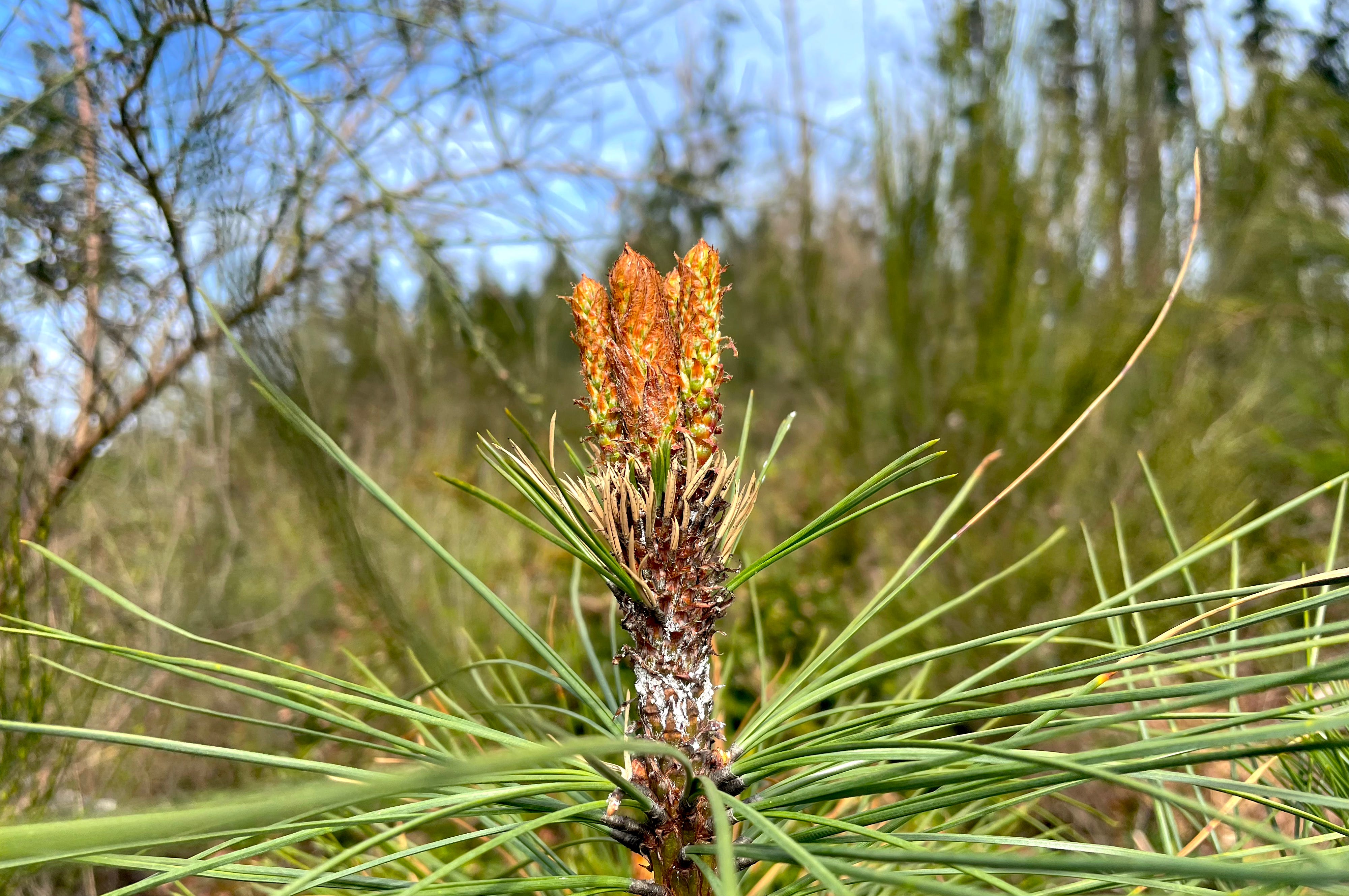
My research question here is to gauge the relative success of Willamette Valley pines planted in the full sun of a clearcut versus the partial shade of the neighboring thinned Douglas-fir forest. What I did not expect, measuring these pines year after year, was that I would begin to know the individuality of each tree and the variability of fate. The ten pines began as an undifferentiated cohort. Each year I find that one or another has caught a lucky break or suffered an injustice, and the measurements I am collecting require annotations, for the numbers reflect settings—microhabitats and twists of fate—far more individualistic than the general tree cover over them.
Last year I came to R02 and my heart dropped. The young needles around its apical candles—on a pine, the elongated growing tips at the top of the crown and the ends of the branches are called candles—were as tan and lifeless as dust. I inspected it and could not formulate a guess as to what ailed it. The candles themselves seemed okay, but what did I know? For the first time my cohort looked likely to drop to nine in number.
But look at that. R02 grew 10 inches last year. It put out perfectly healthy needles along the way. And while there are still some tan needles in the youngest growth, it looks better this year than last.
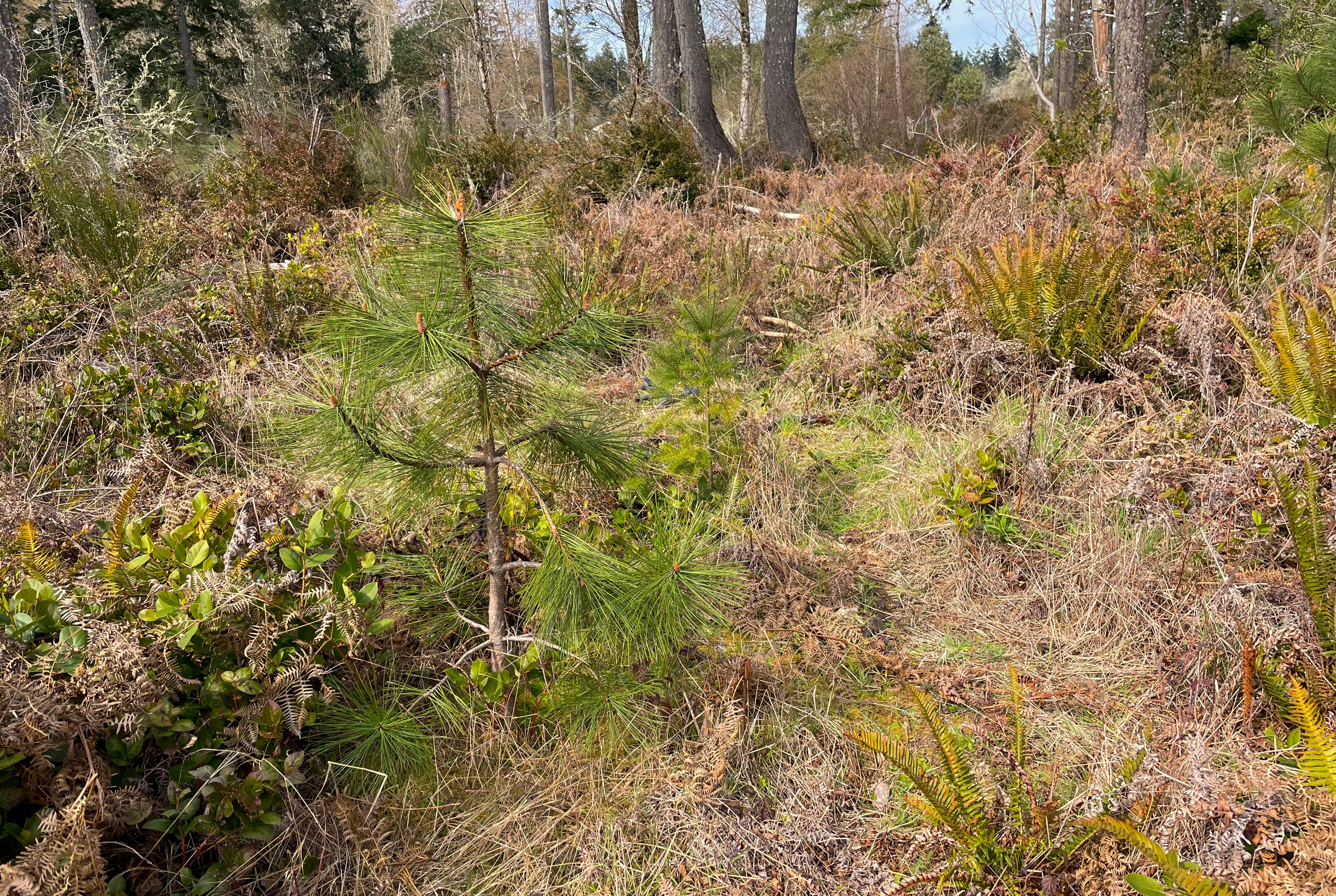
At times I am reminded of the improbability that any young plant should survive its tender years. A deer trail passes by R07—you can see it faintly to the right of the tree. A lot of deer use the Bald, and the trees are just getting to the height that deer love for thrashing with their antlers.
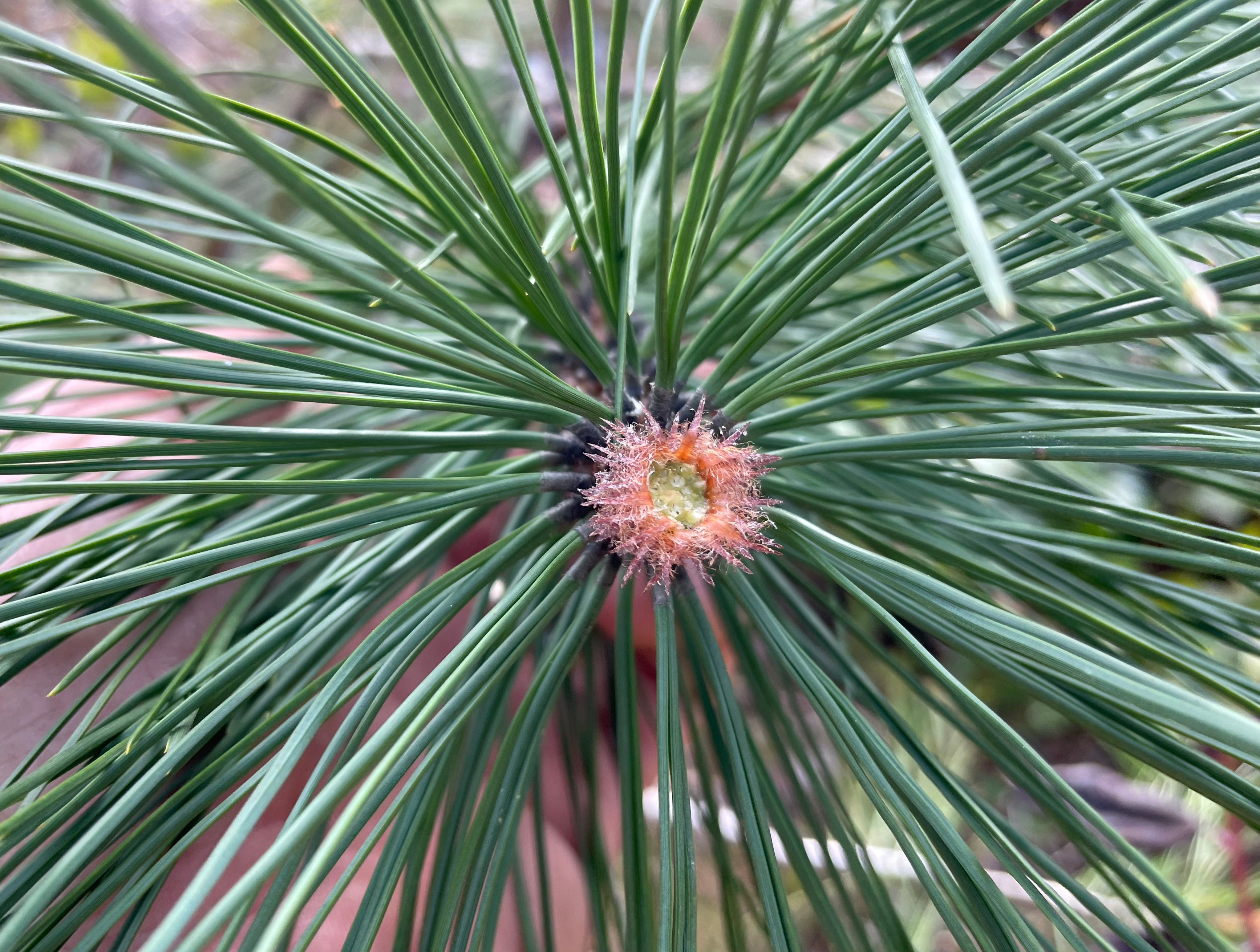
As I bend to measure R07, another runty tree, I brush one of its lower limbs and see something fall. With hardly any force, I have broken the limb’s candle and exposed a tender pith of growth cells. How, again, do these young trees, which can be broken and killed by hand, stand unharmed, though they are totally exposed, for the years it takes until they stand en masse as a forest?
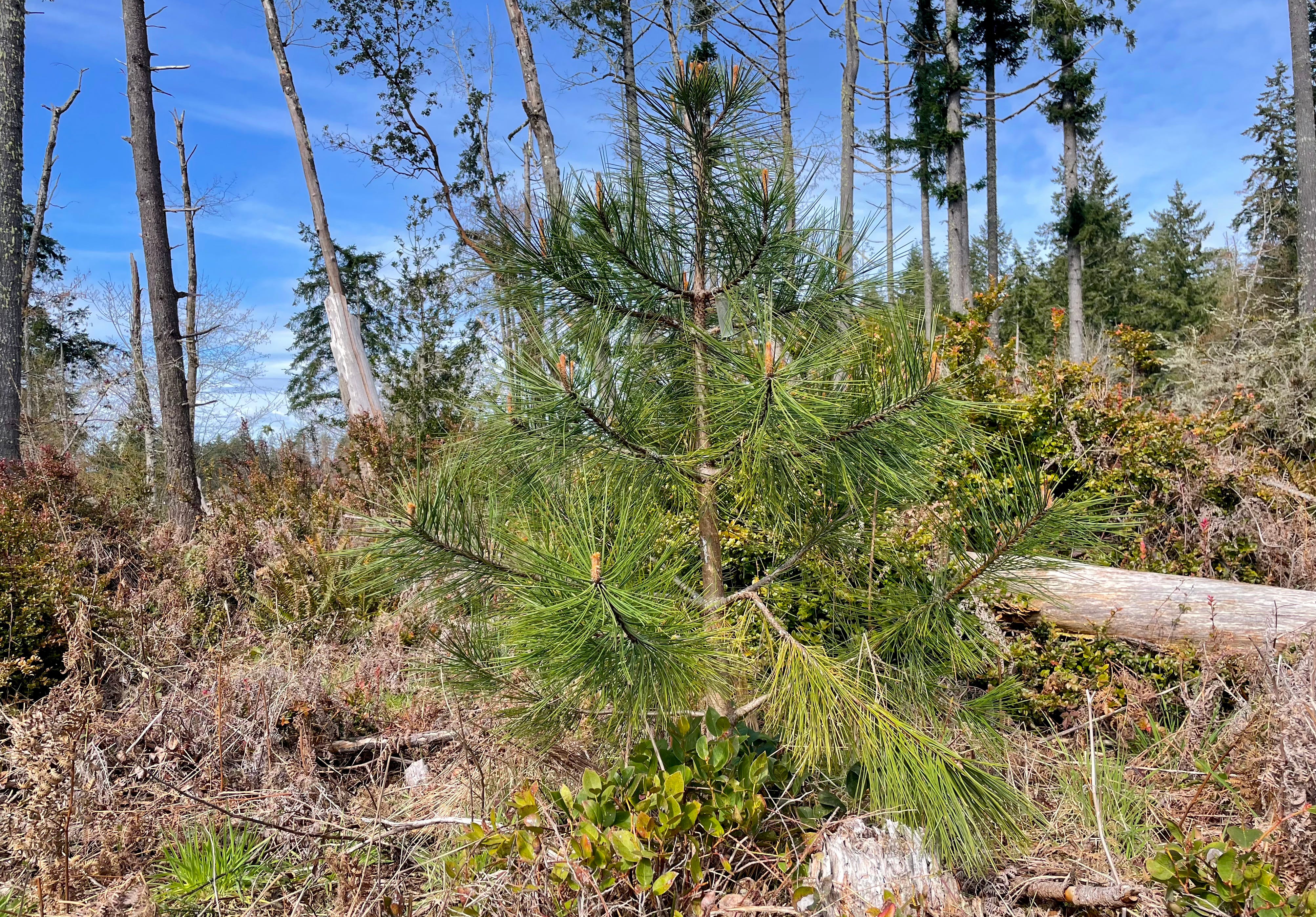
A quick lesson on pine anatomy. A pine demonstrates whorl-based growth. Each year, it puts out a radiation of branches that all depart the trunk at the same height. Count them on R08, starting at the bottom and moving up, and you can get a guess of its age. Five whorls. Five years old.
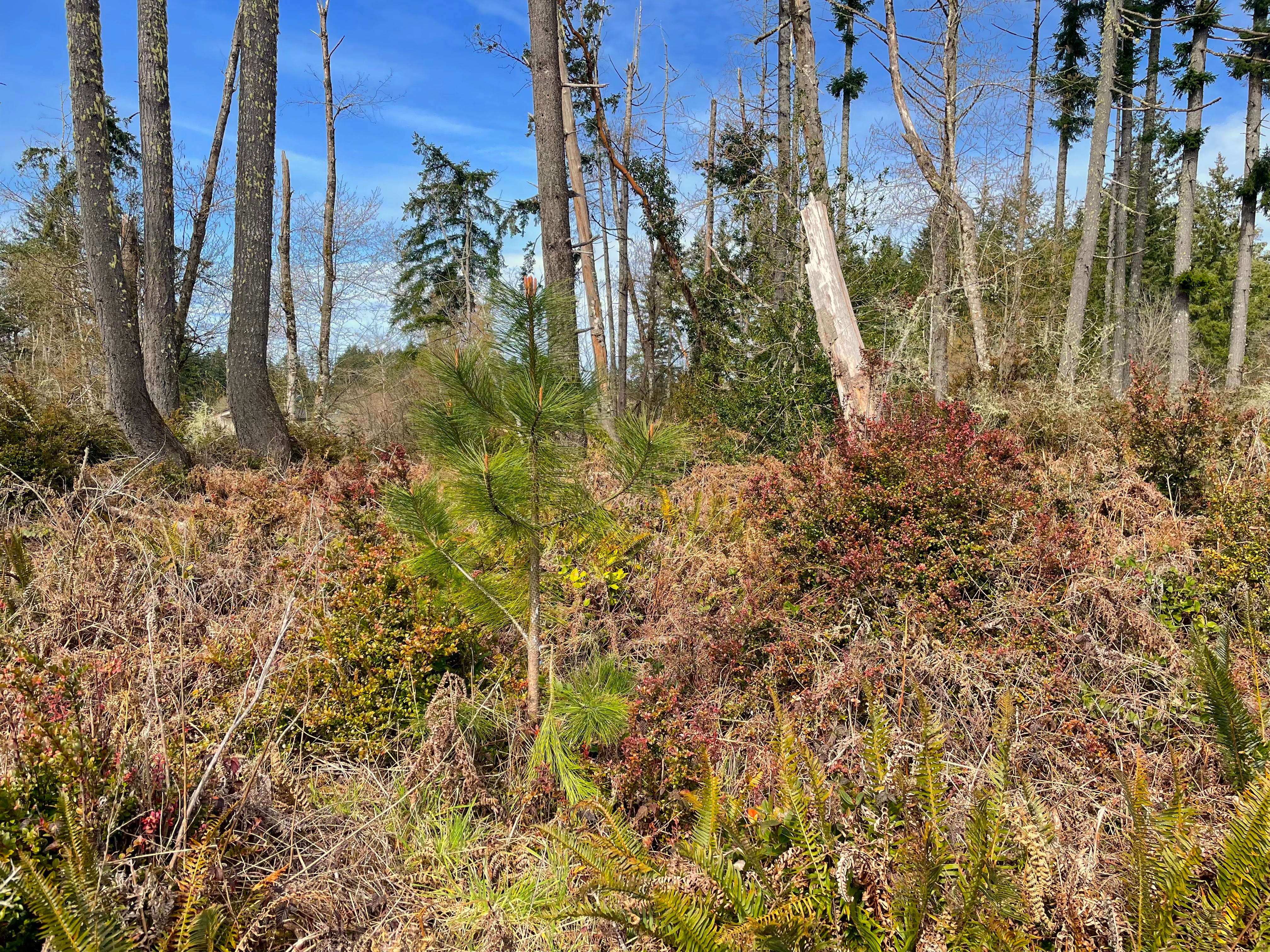
Visiting pines R07 through R10 is a pleasure. The terrain around them remains open with scattered berry shrubs and sword fern. It is early spring, and everywhere leaves are unfolding. Next to R09, evergreen huckleberry creates a reverse image of autumn by unfolding leaves that are burgundy and pink before they harden to green.
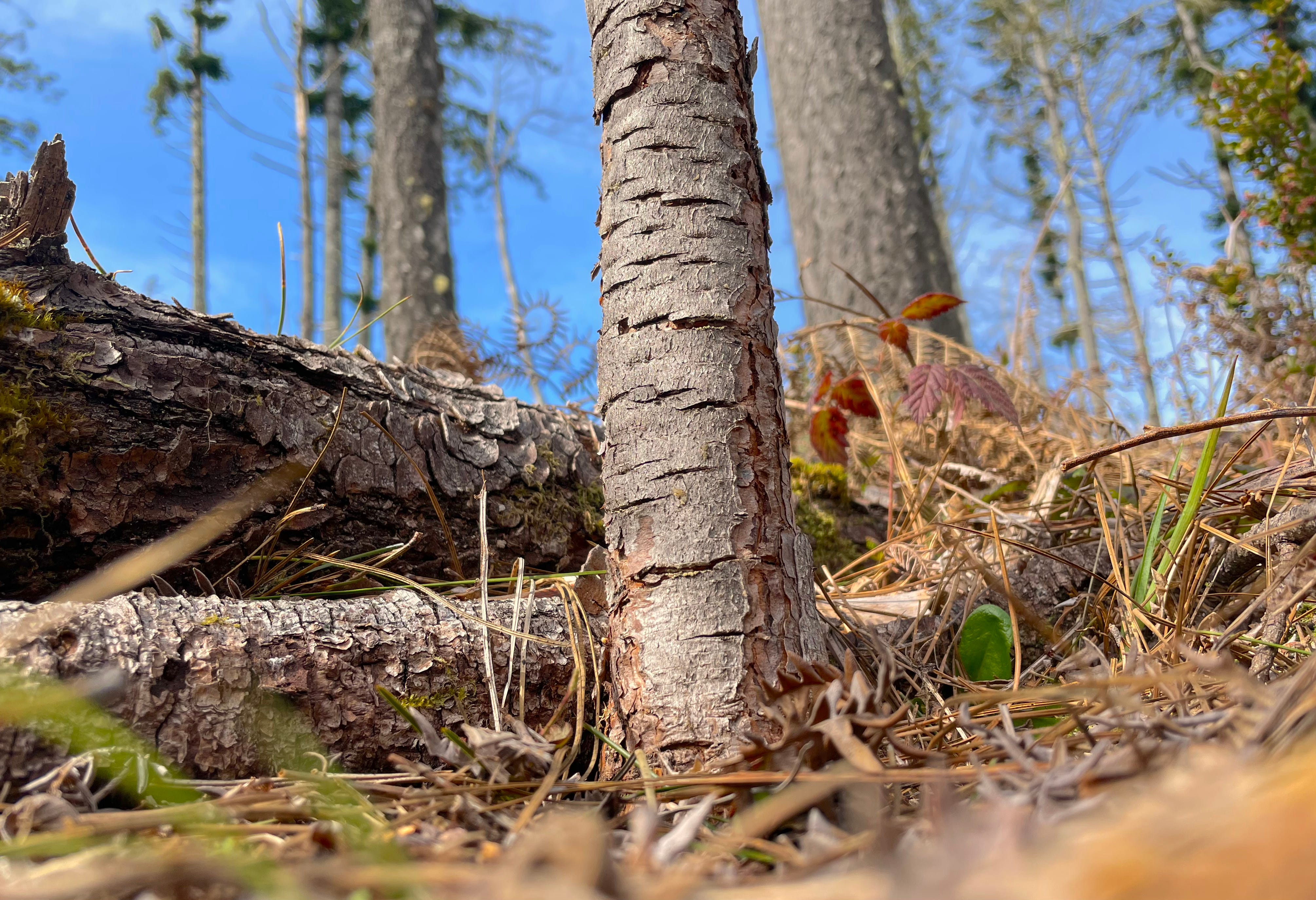
And here it is, mighty R10, an ode to survivorship. An ode also, in this tongue-in-cheek photo, to the photos I more often than not come away with after photography sessions with champion trees, when I can never adequately capture more than a fat slice of trunk.
The fact that R10’s trunk is vertical at all brings me great cheer. Last year I arrived to find it, as I scrawled in my notepad,
Knocked to the ground! Almost horizontal, everything still intact. Branches and needles curved over toward ground on one side. Leaned it up with forked branch and logs. Slight prune. Not completely vertical after propping.
This year I find it growing as straight as ever. It added 16 inches last year and now stands at 68 inches tall.
Measurements complete, I look back across the ten pines and wonder what the next year will bring. More growth, I would hope.
Endnotes
I had to work in a quote from Donald Culross Peattie’s A Natural History of North American Trees—which has become my go-to when I want to grasp a tree’s significance in the American landscape—having just finished his memoir The Road of a Naturalist, published during World War II and full not only of sage-scented descriptions of his journeys through American landscapes but deep grapples with a naturalist’s role in a world of active killing and death. Looking for a quote to drop here, I find it hard to extract his words from their surroundings. Here is a taste of his description of our neck of the woods, which he calls the Great Forest:
A fleck of sunlight on the forest floor is a gold piece. This is a discrete world, like the ocean or the desert. Trees are a power in the Northwest. Directly or indirectly all the wealth, all the luck and fortunes and misfortunes of Americans there depend upon the woods. Before you can turn around to live—to make a road, plant a crop, build a house, walk, sit down, or strike a match to light a pipe—you have to consider the trees.
Pruners in Japanese gardens know all about the candles of pines. In addition to pruning and needling their pines to create dramatic forms, they “candle” their pines, meaning they remove or significantly shorten the candles on a pine’s branches and apical point. This serves to slow growth and direct it into zigzag patterns.
Thanks for reading Infinite Peninsula. Subscribe to receive every ramble and adventure, become a paid subscriber to keep me going, and share with anyone who would dig a spy’s-eye view of the world we share with Cascadia critters.
wonderful! Over the last 6 years we've been moving some volunteer douglas fir seedlings into a pot for a year and then into a place not far from their "mother", a place once scraped free of Himalaya BBs. Logging their growth would have been a good idea. I might start now. I fear the coming drought this summer.
Wow, Chris, your success for the Ponderosa 10 is incredible! My 10 ponderosas (planted 2 years ago) have less sun so are still small and protected. I need to visit The Bald! I want to see these lovelies in person. Of note when I visited JBLM to see the ponderosas in person I learned that they are genetically different than both the Willamette stands and those in Eastern WA. It does not appear that they are gathering seeds from the stands to grow seedlings for us in the west. But no matter, with our droughty conditions worsening seems this facilitated migration strategy is a good idea. Thank you for all you do.