
Geese Falling From Cedars

A new thought: maybe the best yardstick to measure the bounty of our land is the number of eggs it produces.
I mean the eggs of wild birds. If birds not only find our land a nice place to hang out, but know they can source the enormous amount of food it takes to raise youngsters, we should probably feel pretty good about our land’s function in the larger peninsula ecosystem.
And yet, for all the work we put in to restore habitat, plant natives, add dead wood, boost insect populations—sometimes the nests appear in the darnedest of places, like the killdeer that nest in the gravel of our driveway and this year fledged three little puffballs.
A large two-trunked cedar stands just outside my bedroom window. Half the tree is the picture of health. The other half, which leaned toward the house, was cut by the previous owner at least a decade ago. It was cut off flat, 11 feet from the ground, higher than a basketball hoop. Cedar being cedar, rot is minimal, confined to a small hollow at the center of the platform.
That is where, early in April, a Canada goose appeared and settled in. Day after day, my wife and children and I watched her up there, a goose in a tree, strange as a squirrel in a lake. She rarely moved. Only twice, over the course of a month, did we see her on the ground to get a mouthful of grass.
“Goose report,” my daughter said each morning. “Still there.”
Female geese do all the incubating. The males patrol for intruders, though in this case, we hardly saw him. The nest couldn’t have been much safer. But how would the goslings get down? asked everyone who visited and saw the situation. We shook our heads and shrugged. We had the same question.
On May Day, at last, the mother’s stoic pose broke. She bent her head into the hollow to clean or help something down there. That evening, the first gosling tottered around the edge of the platform.
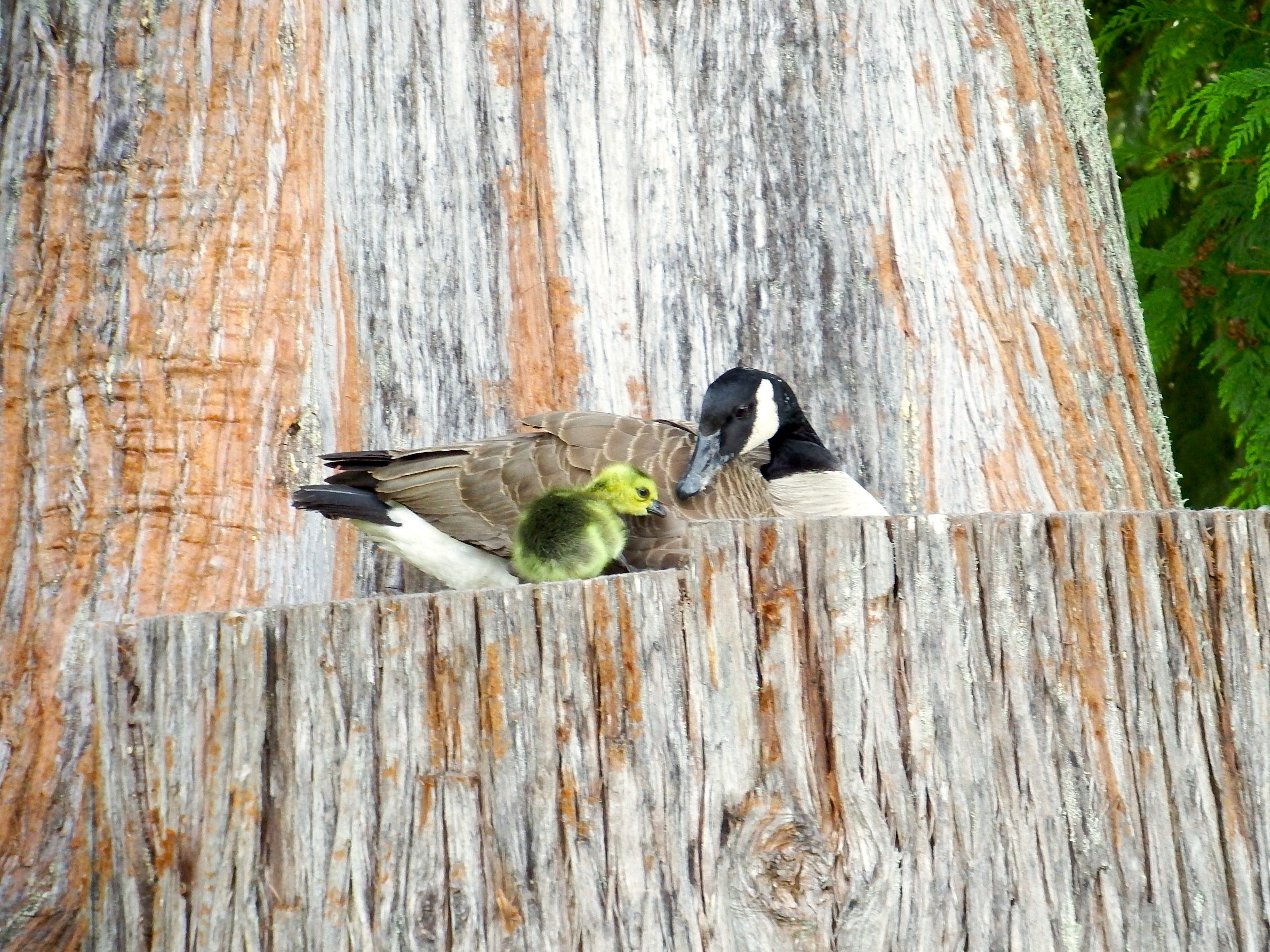
The next morning dawned full of honking. My daughter and I scrambled from our beds. The male had appeared in the pasture grass at the base of the tree. His neck was extended. The female had a piece of down in her beak and seemed restless. Geese do not bring food to their young in the nest; goslings are born able to walk, swim, and graze.
At 7 a.m., the mother had the goslings up. There were four.
Then, without preamble, she crouched next to the cedar’s other trunk. She raised her wings and went over the edge, awkwardly using the crotch between the trunks as a sort of slide. It took us a moment to realize what she had just done. There would be no pushing of goslings out of the tree. She had demonstrated what she expected, and now the goslings had to follow.
Alone up there, they looked at each other and seemed to ask, We’re supposed to do what now?


Then one was falling.
It was one of the most surreal things I have seen. My eyes did not accept the blink of yellow as a falling baby until I saw it on the ground.
The next one came. This time I saw it more clearly. As soon as it began to fall, its infant body locked in a rigid spread-eagle, black feet and stubs of wings held out like the immobile points of a star, and it came down in an arc defined not by biology but physics—heck, maybe astronomy.
We watched the last two fall. I was stunned. They lay on the ground for a moment before they rolled to their feet. They sniffed at the grass. They began to walk. No sign of injury. They were downy and probably as light as empty cans. The parents made no move to rush their first explorations. In a world of brilliant green, they bracketed the goslings and walked with them, over the next hour, toward the pond.


I think of the windy fall days when migratory geese arrive. Our house is a perfect vantage to watch them appear high overhead and take aim at our pond. They cant their wings expertly and sometimes do a barrel roll or two before they flash to a skidding stop on the water. The contrast to the falling goslings could not be more striking.
Sixty years ago, you would be hard-pressed to find a Canada goose in Washington. Their population boom has been startling. It is a story of increasing habitat, especially in suburban areas and irrigated farmland. They are tundra-nesting, grass-eating birds that like open spaces next to water. But there is more to it than that.
Eleven subspecies of Canada geese exist, each with a different nesting range and subtle differences in size, structure, and coloration. In 2004, the American Ornithologists Union split the generally smaller northern birds into a separate species, the Cackling goose. So now we have honkers and cacklers.
One of the largest subspecies, Moffitt’s Canada goose, was reintroduced along the West Coast in the 1960s. It adapted well, mixed with other transplant geese, and learned to tolerate people. It grew flexible in its nesting habits. It did not migrate like its cousins. These are the geese now ubiquitous in parks and golf courses.
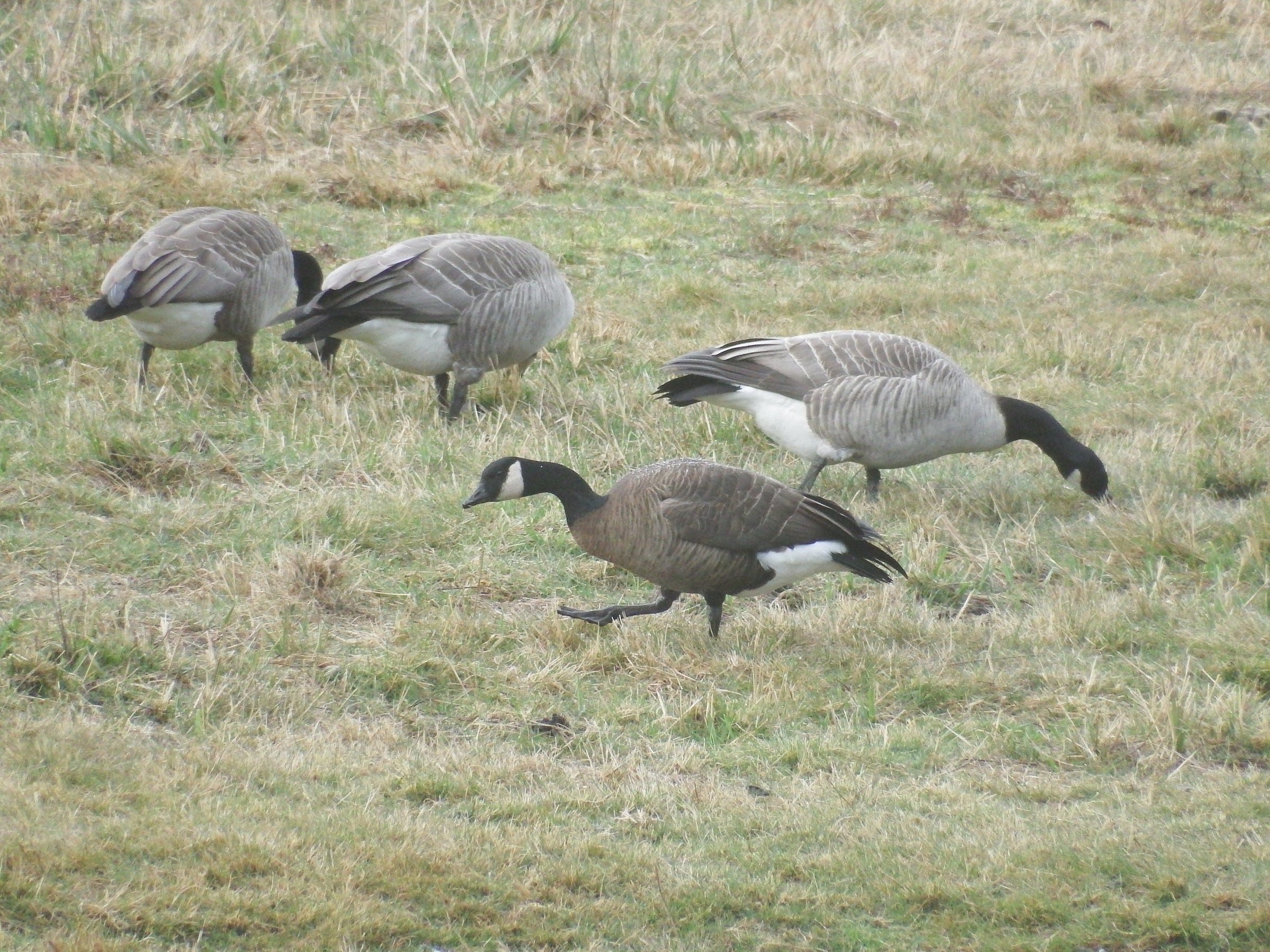
But in the fall, they are joined by their wild cousins, down from Canada and Alaska. On the Key Peninsula, we might see six subspecies of migratory geese. Often they are more wary and flighty than the resident geese. Look for the tiny minima cackling goose, barely bigger than a mallard. Or if you are feeling lucky, look for the endangered dusky Canada goose, whose population was nearly eliminated when the 1964 Good Friday earthquake lifted the Copper River Delta and made its nesting habitat accessible to predators.
Canada geese mate for life. They nest on islands, at tree bases, along shorelines, in marshes, even in unoccupied osprey nests. My favorite is when they nest atop beaver lodges. The goslings cannot fly for their first ten weeks. They stay with their parents for the first year or so. Their migratory patterns are not innate and must be learned alongside parents and flock mates. In suburban areas, mortality of goslings is low thanks to abundant food and the scarcity of predators.
Our pasture is a little more wild than your average suburban park. It wasn’t more than a year ago that we saw young coyotes tumbling where the goslings made their first trip to the pond.
Once the goose family disappeared into the tall rushes around the pond, we did not see them again. That evening, golden light came through a gap in the forest to the west. I peered across the pasture, wishing I could know how the goslings’ first day had gone. I saw a spreading golden vee of ripples in the flooded pasture. Squinting, I made out a family swimming my way. With binoculars I looked and—oh, they were mallards. With tiny ducklings.
Now where was that nest hidden?
Endnotes
Data from the Christmas Bird Count offer dramatic proof of the rise of resident geese (plus the expanded wintering range of migratory geese). Averaged by decade, the Tacoma count had 0 geese in the 1960s, 96.8 per year in the 1970s, 391.4 in the 1980s, and 1,459.4 in the 1990s. The 2025 count had 3591 geese.
The rise of geese in Kitsap County—our neighbor to the north, and a better analogue than the urban/suburban landscape of Tacoma—has been more modest. The Kitsap Christmas Bird Count averaged 0 geese in the 1960s, 0.7 in the 1970s, 45.3 in the 1980s, and 242.6 in the 1990s. The 2025 count had 469 geese.
A dusky Canada goose paid a visit to our pasture in March of 2023. More on the story of their decline is here. Hunters pay close attention to subspecies of Canada goose and know duskies well, as they are the one subspecies it is illegal to harvest.
Thanks for reading Infinite Peninsula. Subscribe to receive every ramble and adventure, become a paid subscriber to keep me going, and share with anyone who would dig a spy’s-eye view of the world we share with Cascadia critters, from the mighty to the small (and falling).
I loved this story. Living on Burley Lagoon is a paradise when it comes to birdwatching. This year the Canada geese are everywhere and thriving. We have a stream of artesian water that flows onto the beach and it is a favorite spot for the geese to drink and a cool place to hang out when it is hot. It seems, too, that the heron population has grown and they seem to be finding plenty to eat when the tide is real low.
Thanks for another great article Chris.
What a great story. It's a moment of awe when wildlife teaches us something outside our expectations. So many wonderful things your kids are learning!